Learning how to tell if saffron is real is less about finding one magic test and more about building a convincing body of evidence. Before buying, inspect the label, seller information, pack size, product form and claims. After opening the pack, examine the threads, aroma, texture and the way the saffron blooms in warm water. Each check can reveal warning signs, but none can conclusively prove purity at home.
The short answer: how can you tell if saffron is real?
Real saffron is made from the dried stigmas of Crocus sativus. Genuine threads are usually deep red to red-orange, irregular rather than mechanically identical, and often wider or slightly flared at one end. They should have a distinctive, complex aroma and gradually release a clear golden-yellow to orange colour when placed in warm water.
Use the following checks together:
- Inspect the seller: choose an identifiable retailer that provides clear contact and product information.
- Read the full label: check the food name, pack weight, business details, date information, storage guidance and any origin statement.
- Prefer visible threads: they provide more structural information than an unlabelled powder.
- Examine shape and colour: look for natural variation, recognisable stigma structure and an absence of obviously unrelated fibres.
- Smell the saffron: the aroma should be distinctive and layered rather than simply perfumed or sweet.
- Bloom a few threads: watch both the colour of the water and the condition of the threads over time.
No saffron water test, photograph, aroma check or price comparison can conclusively establish authenticity. Laboratory methods are needed for firm conclusions about purity, adulterants and formal quality classification. ISO 3632 provides recognised testing methods for dried saffron, including filaments, cut filaments and powder. ([iso.org](https://www.iso.org/news/2014/02/Ref1819.html?utm_source=openai))
Why saffron authenticity matters to UK shoppers
Saffron is valuable, labour-intensive to produce and normally sold in very small quantities. Those characteristics make it vulnerable to deliberate substitution, added plant material, artificial colouring, excess moisture, misleading origin statements and exaggerated grade claims. A pack may contain genuine saffron mixed with lower-value material, or a product may be authentic but marketed as a better grade than it really is.
This should encourage careful buying rather than unnecessary alarm. Most shoppers do not need specialist equipment, but they should avoid relying on packaging language alone. The UK Food Standards Agency distinguishes between practices such as adulteration, substitution and misrepresentation, all of which can affect whether food is what its label claims. An FSA update published in 2026 also noted that an industry alert concerning dye-adulterated saffron had been issued during 2025. ([food.gov.uk](https://www.food.gov.uk/safety-hygiene/food-crime?utm_source=openai))
The practical response is to buy from a traceable source, retain the packaging and receipt, and treat home observations as screening clues rather than a laboratory verdict.
What real saffron actually is
Culinary saffron comes from the flower of Crocus sativus. Each flower produces three stigma lobes, which are separated and dried. Depending on how the saffron is prepared and graded, a thread may consist mainly of the red stigma or may retain a smaller amount of its attached orange or yellow style.
This natural structure is useful because a genuine whole stigma does not normally resemble a perfectly straight, smooth fibre of uniform width. Under magnification, the broader end has a trumpet-like or flared form with a textured margin. Ordinary shoppers may not see microscopic details, but a phone camera or basic magnifying glass can still reveal whether the pack contains naturally varied botanical structures or suspiciously uniform strips. ([pmc.ncbi.nlm.nih.gov](https://pmc.ncbi.nlm.nih.gov/articles/PMC9417335/?utm_source=openai))
Saffron threads, cut threads and powder
Whole or relatively intact threads provide the most visual information. You can compare their widths, ends, surfaces and colour distribution, and you can observe what happens to the same threads during blooming.
Cut saffron is not automatically inferior or fake. Cutting may simply remove parts of the style or produce a more uniform commercial format. However, very short fragments offer fewer visible clues than intact stigmas.
Powdered saffron is also not automatically fake. It can be convenient for measuring and disperses quickly in recipes. The difficulty is that grinding removes the natural stigma structure and makes added powders or colourants much harder for a consumer to detect. If you buy powder, retailer credibility, a complete label and traceability become especially important.
Real saffron versus high-quality saffron
Authenticity and quality answer different questions. Authenticity asks whether the product is genuinely saffron and whether undeclared material has been added. Quality concerns factors such as aroma, colouring strength, flavour, moisture, age, storage and the proportion of stigma to style.
A genuine pack can be old, weak, damp or poorly stored. Equally, long and attractive red threads are not conclusive proof of purity because other fibres can be shaped or dyed to look convincing. A responsible saffron buyer therefore asks two questions: “Is this consistent with real saffron?” and “Does its condition and performance justify the quality claim?”
How to inspect saffron before you buy it
A repeatable buying process is more reliable than choosing a pack because it looks luxurious. The following checks work in supermarkets, specialist grocers and online shops, although online buyers must depend more heavily on listing quality and seller transparency.
Choose threads when you want to inspect the product
If authenticity is your main concern, choose saffron threads in packaging that lets you see at least part of the product. Avoid assuming that every opaque tin is suspicious; light-resistant packaging can help protect spices. Instead, look for detailed product images and a clear statement that tells you whether the contents are whole threads, cut filaments or powder.
A small thread pack such as Golestan Khatam Design Saffron Threads 1g illustrates a format in which the product form and net weight are stated explicitly. That does not replace inspection, but it gives the buyer a clearer starting point than an unlabelled bag of red powder.
Read the entire UK food label
Do not stop at the brand name or the large word “saffron” on the front. Turn the pack over and inspect all available information:
- Name of the food: it should make the product form reasonably clear.
- Ingredients: where an ingredients list is present for pure saffron, look for saffron or Crocus sativus without undeclared fillers. A single-ingredient food may not always require a separate ingredients list, so its absence alone is not proof of a problem.
- Net quantity: compare products in grams rather than judging them by the physical size of the box.
- Business information: look for the name and physical address of the responsible food business or importer.
- Date and lot details: check the best-before information and any batch or lot code shown.
- Storage instructions: follow any conditions supplied by the packer.
- Origin information: note the country or place of origin where it is stated. Origin information is not mandatory for every spice in every circumstance, but presentation must not mislead shoppers.
- Package integrity: avoid packs with broken seals, unexplained punctures, moisture marks or signs of tampering.
UK food information must be clear, visible, understandable and not misleading. For food sold online, most mandatory information must also be available before purchase, with limited exceptions such as the durability date. ([gov.uk](https://www.gov.uk/guidance/food-labelling-giving-food-information-to-consumers?utm_source=openai))
Treat grade names and premium language cautiously
Words such as “premium”, “finest” and “luxury” are marketing language, not laboratory evidence. Names including Negin, Super Negin, Sargol, Pushal and Dasteh generally refer to how Iranian or Persian saffron has been separated, cut and presented. They can help describe thread appearance, but the printed grade name does not independently prove purity, freshness or colouring strength.
For a fuller explanation of these terms, consult the guide to Persian saffron grades, storage and use before comparing packs.
Compare the price with the weight and claimed grade
Always convert the offer to a price per gram. A decorative box can make a very small quantity look substantial, while two similar-looking packs may contain quite different weights.
An implausibly cheap offer is a warning sign because genuine saffron requires substantial manual harvesting and processing. It is not definitive proof of fraud, however. A lower price could also reflect a different pack format, a higher proportion of style, older stock, a less elaborate presentation or ordinary retailer pricing decisions.
Compare like with like: threads against threads, equivalent weights against each other, and similar claimed grades. For example, a buyer considering a larger thread pack could compare the stated weight and intended usage of Golestan Iranian Saffron Half Mesghal with those of smaller packs rather than comparing box prices alone.
Check the retailer and traceability information
A trustworthy-looking website is not enough. Ask practical questions:
- Is the seller’s business identity and contact information easy to find?
- Does the listing state the net weight and whether the product is threads, cut saffron or powder?
- Are the product photographs consistent with the description?
- Does the pack shown have legible business and date information?
- Can the seller answer a reasonable question about origin, batch identification or supporting analysis where applicable?
- Are complaints, returns and delivery terms presented clearly?
If you are assessing an unfamiliar specialist shop, use a broader checklist for choosing an Iranian grocery store in the UK. Buyers building a larger basket may also find it useful to review the practical considerations involved in buying Middle Eastern groceries online.
Seven signs to examine after opening the pack
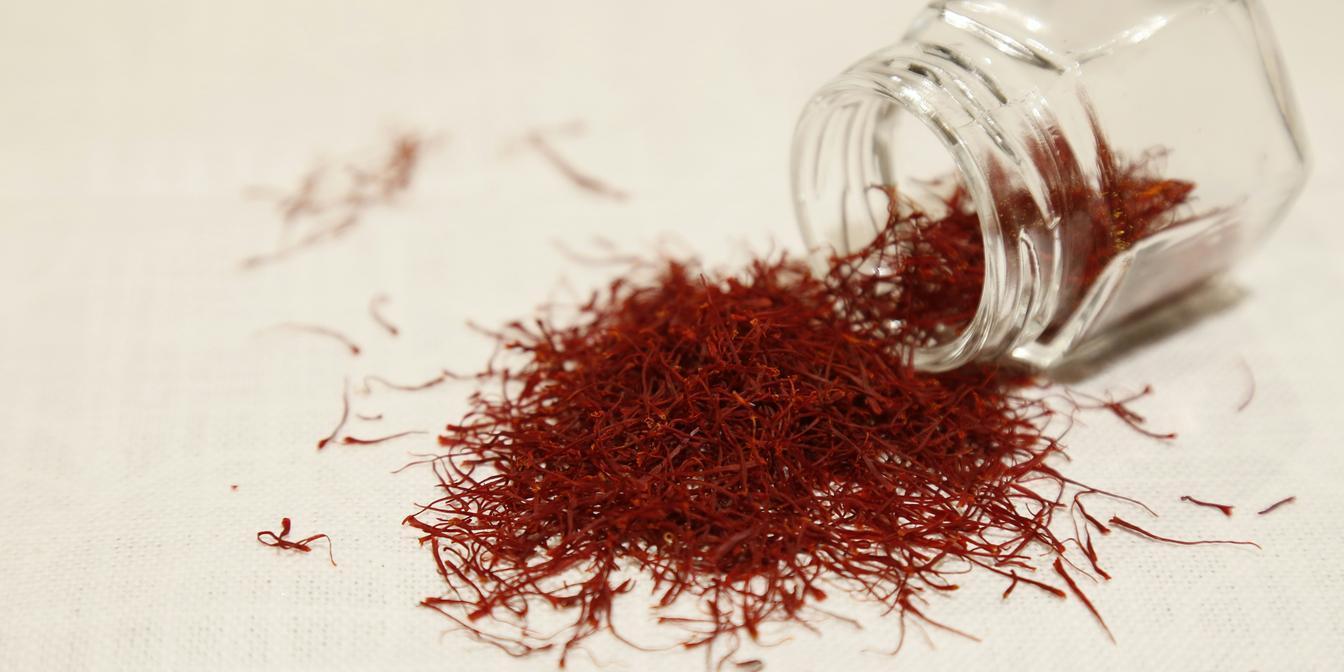
Once you have opened the saffron, inspect it in bright, neutral light. Spread a small amount on a white plate or sheet of plain paper so that individual threads are visible. The signs below are clues, not standalone verdicts.
1. Look for natural stigma shapes
Many intact saffron threads taper from a broader, slightly flared or trumpet-like end towards a narrower section. Their edges and surfaces are not perfectly smooth. Thread length varies because stigmas can break during processing and packing.
Be cautious if every piece looks like an identical straight strand, a smooth strip of paper, a flat fibre of uniform width or a thread with obviously cut rectangular ends. Remember that heavily cut genuine saffron may not retain the broad tip, so the absence of trumpet-shaped ends is a reason for further checking rather than immediate rejection.
2. Examine the colour distribution
Real saffron threads are commonly deep crimson, red or red-orange. Some authentic preparations contain a limited amount of lighter orange or yellow style. This may affect grade and colouring strength, but it does not automatically mean that the product is fake.
Warning signs include lurid or fluorescent colour, surface dye that transfers heavily with minimal contact, and mixed fibres whose colour appears concentrated only on the outside. Colour alone remains unreliable because genuine saffron varies and sophisticated imitations can be dyed convincingly.
3. Assess the aroma without expecting perfume
Saffron aroma is distinctive but difficult to reduce to one comparison. People may describe it as dry, hay-like, floral, earthy, honeyed or slightly metallic. It should normally smell complex rather than like a simple sweet fragrance or generic spice flavouring.
A weak aroma does not necessarily prove substitution; age, a loose seal or poor storage can reduce aromatic intensity. Conversely, a strong added fragrance can imitate one aspect of saffron. Treat aroma as one part of the overall assessment.
4. Notice dryness, clumping and residue
Saffron threads should generally feel dry and lightweight. A pack that seems unexpectedly heavy for its stated volume, contains damp clumps or leaves an oily or sticky residue deserves closer scrutiny. These signs could relate to moisture, storage conditions or added material, but a home inspection cannot determine the cause.
Very dry saffron may break when handled, so broken pieces are not automatically a defect. Judge whether the fragments still resemble natural plant tissue rather than manufactured fibres.
5. Check for inconsistent plant material
Look through several pinches rather than examining one attractive thread from the top. Check for petals, stalks, smooth fibres, unusually broad strips, granules or large quantities of coloured dust. Genuine saffron may contain occasional broken fragments, but a visibly mixed assortment of unrelated structures is a warning sign.
Also notice whether all the colour and larger threads appear at the top while pale debris has settled underneath. Turn the closed container gently before opening if the packaging allows, then inspect material from different parts of the pack.
6. Watch how the threads release colour
When placed in warm water, genuine saffron should colour the liquid yellow, golden or yellow-orange. The colour usually develops progressively rather than forming an opaque red drink. Some genuine cut or crushed saffron can begin releasing colour quickly because more surface area is exposed, so “instant colour equals fake” is too simplistic.
A sudden concentrated red plume, intense surface dye or threads that become pale almost immediately may justify concern, especially when combined with suspicious shape or aroma.
7. Re-examine the soaked threads
Do not inspect only the water. Lift or view the threads after they have soaked. Genuine stigma tissue should remain recognisable, although it will soften and may gradually lose colour. Paper-like strips that disintegrate, smooth fibres that reveal a pale core or material that rapidly loses all surface colour may be imitations.
The soaked-thread check is particularly valuable because it combines structure, colour distribution and behaviour. It still cannot detect every form of adulteration, including a mixture containing both genuine saffron and carefully prepared substitutes.
A sensible way to perform the warm-water check
The popular saffron water test is useful when performed carefully and interpreted modestly. Its purpose is to observe the sample, not to issue a definitive pass or fail.
- Use a clean, clear, colourless glass.
- Add a small quantity of warm water. Avoid coloured liquids, milk and heavily mineral-stained cups because they make the result harder to see.
- Place several uncrushed threads on the surface.
- Watch the first minute for an obvious surface dye plume.
- Continue observing for 10 to 20 minutes as the colour spreads through the water.
- Leave the glass longer if needed; genuine saffron may continue developing colour and aroma beyond the initial observation period.
- Inspect the softened threads as well as the liquid.
Real saffron often begins releasing colour within a few minutes, but there is no universal pass-or-fail time. Water temperature, thread size, whether the stigmas are whole or cut, age, storage and the amount used all affect blooming speed. Crushed genuine saffron can colour water faster than intact threads.
Focus on the combined pattern: clear golden-yellow to orange liquid, a developing saffron aroma and threads that remain recognisable. A bright red liquid is not the expected culinary result simply because the original threads were red. However, do not reject a pack solely because its colour develops faster or slower than an online demonstration.
Common saffron tests you should not trust on their own
The instant-colour rule
The claim that real saffron always takes a fixed number of minutes to release any colour is misleading. Genuine cut, crushed or finely broken material can begin colouring warm water quickly. The character and progression of the colour are more useful than timing alone.
The finger-rub or paper test
Rubbing threads between wet fingers or on paper may reveal a loosely applied surface colour, but genuine saffron pigment can also transfer. Pressure damages the sample and produces an ambiguous result, so use observation in water instead.
The taste test
Genuine saffron has a characteristic bitter dimension, but taste is subjective and can be imitated or masked. It also cannot reveal every undeclared plant fibre or colouring agent. Aroma and flavour should support other evidence, not replace it.
The “all-red threads mean premium” rule
A high proportion of red stigma is associated with certain commercial presentations, but colour selection is not proof of authenticity. Dyed substitutes can also be red, while genuine grades that retain part of the style may contain orange or yellow sections.
The cheapest-or-most-expensive rule
Price is a screening clue, not evidence. A very low price should prompt more questions, but an expensive pack can still be mislabelled. Packaging, traceability and product performance matter at every price point.
What to do if your saffron seems suspicious
Start by documenting what you found. Photograph the sealed or opened packaging, the label, lot code, threads and warm-water result. Retain the receipt or order confirmation and avoid discarding the remaining product while you contact the seller.
Ask for a clear explanation of the product form, origin statement, batch information and any quality or analysis documentation behind prominent claims. A responsible retailer should be able to investigate a specific pack rather than simply repeating marketing language.
If you believe the product has been deliberately misrepresented, you can raise the matter with the relevant local authority or the Food Standards Agency’s food-crime reporting service. Describe observations accurately: for example, “the pack contained smooth pale fibres that lost red surface colour in water” is more useful than declaring the product fake without analysis.
Store saffron properly after purchase
Authentic saffron can lose aroma and colouring strength when stored badly, creating the impression that it was poor quality from the beginning. Keep it tightly closed in its original inner container or transfer it to a clean, airtight spice jar. Store the container in a cool, dry, dark cupboard away from direct sunlight, steam and strong-smelling foods.
Open the container only as long as needed and use dry utensils. Retain the outer packaging if it carries the best-before date, lot code, origin statement or retailer information. Writing the opening date on the pack can also help you judge changes in aroma over time.
Good storage is especially worthwhile when saffron is reserved for dishes such as chelo and tahdig. The separate guide to choosing Persian rice for tahdig and everyday cooking explains how rice variety and cooking method affect the finished dish.
A practical saffron buyer checklist
Before placing saffron in your basket, work through this final checklist:
- Is the retailer identifiable and contactable?
- Does the listing clearly say threads, cut threads or powder?
- Is the net weight stated in grams?
- Can you see or inspect the product form?
- Are the label, business details and date information clear?
- Is any origin or grade claim explained rather than merely displayed?
- Does the price per gram seem plausible compared with similar formats?
- Is the seal intact and the product free from visible moisture?
- Do the opened threads show natural variation and stigma-like structure?
- Does a small sample produce a developing golden infusion while remaining recognisable?
If most of these checks are satisfactory, you have better practical grounds for confidence. If several warning signs appear together, ask the retailer for clarification or choose a product with stronger traceability.
The bottom line
The best answer to how to tell if saffron is real is to combine evidence. Start with a credible retailer and a complete label, compare price per gram, prefer inspectable threads and treat premium grade names cautiously. After opening, assess shape, colour, aroma, dryness, consistency and warm-water behaviour.
Home checks can identify obvious warning signs, but they cannot prove absolute purity or detect every sophisticated adulterant. Use them as a practical buying filter, while recognising that conclusive authenticity and formal quality grading require appropriate laboratory analysis.
Frequently Asked Questions
What is the easiest way to tell if saffron is real?
Inspect whole threads in warm water. Genuine saffron commonly has naturally varied, stigma-like threads that gradually produce a clear golden-yellow to orange infusion while remaining recognisable. Combine this with label and retailer checks because no home test proves purity.
Does real saffron turn water yellow or red?
Real saffron normally turns water golden yellow, yellow-orange or orange rather than producing an opaque red drink. A sudden bright-red dye plume can be a warning sign, although colour must be assessed alongside the threads, aroma and product label.
How long should real saffron take to release colour in warm water?
It often starts releasing colour within a few minutes and becomes stronger over 10 to 20 minutes, sometimes continuing for longer. There is no fixed pass-or-fail time because temperature, thread size, crushing, age and storage affect blooming speed.
Can fake saffron still smell like saffron?
Yes. Added fragrance, a mixture containing some genuine saffron or another aromatic ingredient may create a convincing smell. Aroma is useful only when combined with thread structure, label, seller traceability and blooming behaviour.
Is all powdered saffron fake?
No. Genuine saffron can be sold as powder for convenient measuring and faster dispersion. However, grinding removes the visible stigma structure and makes undeclared additions harder for an ordinary buyer to identify, so traceability and clear labelling are especially important.